
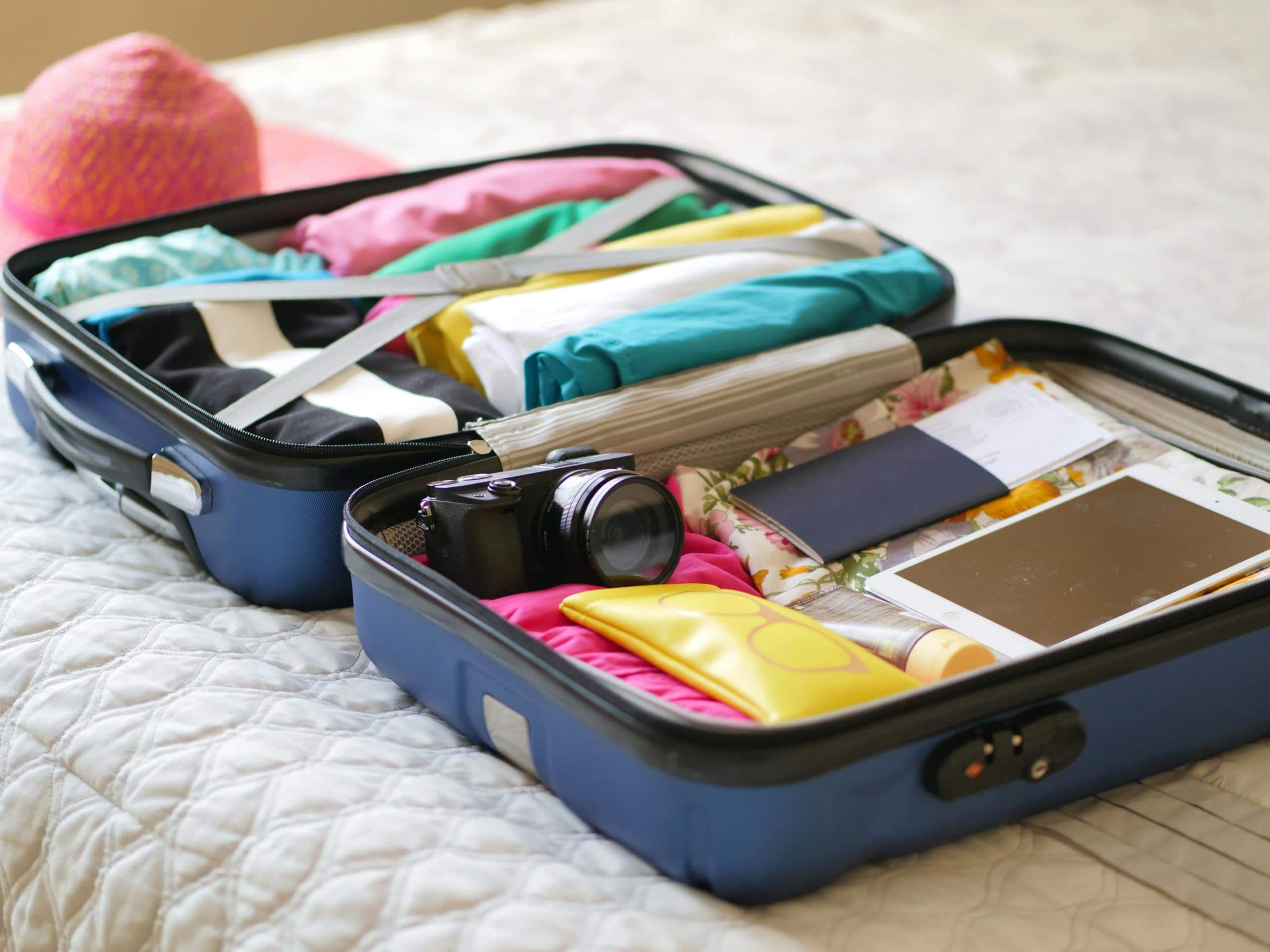
The Ultimate Packing List for Europe: What to Pack and What to Skip
Planning a trip to Europe but staring at an empty suitcase wondering what to pack?
Between unpredictable weather, cobblestone streets, train travel, and trying to fit everything into one suitcase, packing for Europe can feel overwhelming.
After years of traveling throughout Europe, I’ve learned that packing more doesn’t necessarily mean packing better. I’ve dragged heavy luggage through train stations, packed outfits I never wore, and learned which travel essentials actually earn their place in my suitcase.
Now, I focus on versatile clothing, comfortable shoes, and a few carefully chosen travel essentials that make exploring Europe easier.
In this Europe packing list, I’ll share exactly what to bring, what to leave behind, and how to adjust your packing list for different seasons and destinations.
Whether you’re visiting London, exploring Italy, or traveling between several European cities, this guide will help you pack confidently without bringing your entire closet.
Affiliate Disclaimer: Some links on this blog are affiliate links. This means that, at no additional cost, the author may earn a small commission if you purchase through these links. As an Amazon Associate, I earn from qualifying purchases.
Europe Packing List: The Essentials at a Glance
If you’re wondering what to pack for a trip to Europe, start with these essentials. Your exact packing list will depend on the season, destination, and trip length, but this is a practical starting point for most city-focused European vacations.
Clothing and Shoes
- 5 versatile tops
- 3–4 bottoms that mix and match
- 1 dressier outfit for evenings
- 1–2 layers, such as a sweater or cardigan
- A weather-appropriate jacket
- 2 pairs of comfortable walking shoes, plus an optional third pair
- Underwear, socks, and sleepwear
- Activewear or swimwear, depending on your itinerary
Toiletries and Personal Items
- Travel-size toiletries
- Prescription medications in appropriate packaging
- Sunscreen and basic skincare
- Personal hygiene essentials
- Small first-aid kit
Electronics
- Phone and charging cable
- European plug adapter appropriate for your destinations
- Portable power bank
- Headphones
- Camera or other electronics you regularly use
Travel Documents and Money
- Passport and required travel authorizations
- Travel insurance information
- Credit and debit cards
- Digital copies of important reservations
- Any necessary tickets or transportation confirmations
Luggage and Travel Accessories
- Suitcase or travel backpack
- Personal item or day bag
- Packing cubes
- Reusable water bottle
- Foldable tote bag
- Compact umbrella or packable rain jacket
CT Tip: Before packing anything, check your itinerary and the weather forecast for each destination. A week exploring European cities requires a different wardrobe than a hiking trip in the Alps or a beach vacation in Greece.
Want a Printable Europe Packing Checklist?
Skip the last-minute packing panic!
Download my free Europe Packing List for Men & Women, complete with clothing essentials, travel accessories, seasonal packing tips, and space to customize your list.
Keep it handy while packing so you can check everything off before your trip.
How I Pack for Europe Without Overpacking
After years of traveling throughout Europe, I’ve found that combining a capsule wardrobe with the 5-4-3-2-1 packing method works best for me.
Instead of packing an outfit for every day, I choose versatile clothing that I can mix and match. This keeps my suitcase manageable while giving me enough options for sightseeing, dinners, and different weather conditions.
My 5-4-3-2-1 Packing Formula for Europe
Here’s the basic formula I use when planning my European travel wardrobe:
- 5 tops: A mix of casual and dressier options
- 4 bottoms: Pants, jeans, skirts, or shorts appropriate for the season
- 3 pairs of shoes: Comfortable walking shoes and options for planned activities
- 2 layers: Sweaters, cardigans, or jackets
- 1 dressier outfit: Something suitable for a special dinner or evening out
I adjust this formula depending on the destination, weather, and activities. For longer trips, I plan to do laundry rather than packing more outfits.
Build a Mix-and-Match Capsule Wardrobe
The easiest way to make this formula work is to choose a simple color palette.
Start with two or three neutral colors, then add a few pieces that coordinate with everything else.
For example, a pair of black pants can work for daytime sightseeing and evening dinner. You can wear a lightweight sweater on its own or layer it under a jacket when temperatures drop.
Before adding anything to my suitcase, I ask myself whether I can wear it with at least two or three other pieces.
Plan for Laundry on Longer Trips
If you’re traveling for more than a week, consider doing laundry instead of packing additional clothing.
Some vacation rentals and hotels offer laundry facilities, and many European cities have laundromats and laundry services.
Check your accommodations before departure so you know what options you’ll have.
CT Tip: I always leave a little extra room in my suitcase for souvenirs and purchases. Packing fewer pieces at the beginning of a trip makes traveling between destinations much easier.
How to Use This Packing List (Without Getting Overwhelmed)
If you’re feeling unsure where to start, you’re not alone. Packing for a European trip can feel overwhelming, especially when you’re preparing for multiple countries, climates, and activities without overpacking.
That’s why this list isn’t just a checklist—it’s a curated, flexible system designed to take the pressure off.
Here’s how to use it:
- Scan the complete list once to get a big-picture view.
- Use the seasonal and activity sections to personalize your essentials.
- Print or save the checklist so you don’t second-guess yourself the night before your flight.
Whether you’re a planner or a last-minute packer, this guide will help you bring exactly what you need—no fluff, no stress.
Let’s get you packed and on your way to a trip you’ll enjoy from the start.
What Clothes to Pack for Europe
When packing for Europe, I focus on versatile clothing that works for sightseeing, train travel, and evenings out without filling my suitcase.
I typically travel through Europe with carry-on luggage only, especially during spring, summer, and fall. I’ve learned that packing fewer pieces that work together is much easier than hauling a heavy suitcase through train stations, up hotel stairs, and across cobblestone streets.
Winter is the exception. When I’m traveling somewhere cold, especially during European Christmas market season, I sometimes check a bag to accommodate heavier coats, boots, and warm layers.
The secret isn’t packing an outfit for every day. It’s choosing pieces you can mix and match throughout your trip.
My Europe Travel Clothing Checklist
For a typical European trip during spring, summer, or early fall, here’s where I start:
| Clothing Item | How Many to Pack |
|---|---|
| Tops | 4–5 versatile tops |
| Bottoms | 3–4 pairs of pants, shorts, or skirts |
| Dress or dressy outfit | 1 |
| Sweater or cardigan | 1–2 |
| Weather-appropriate jacket | 1 |
| Comfortable walking shoes | 2 pairs |
| Optional dressier shoes or sandals | 1 pair |
| Underwear | 5–7 pairs |
| Socks | 5–7 pairs |
| Sleepwear | 1–2 sets |
| Activewear or swimwear | As needed for your itinerary |
These quantities are a starting point, not a strict rule. I adjust them depending on the weather, planned activities, and access to laundry.
For longer trips, I would rather wash a few items than pack two weeks’ worth of clothing.
Packing for a European trip with your partner? I’ve also created a men’s packing list for Europe with clothing recommendations, travel essentials, and seasonal packing advice to make preparing for your trip easier.
Build a Capsule Wardrobe for Europe
One of my favorite ways to pack light is to create a capsule wardrobe.
I choose a simple color palette so that most of my tops, bottoms, and layers work together. Neutral colors like black, navy, white, and beige make it easy to create several outfits from a relatively small number of pieces.
For example, a pair of black pants can work for sightseeing during the day and a nice dinner in the evening. Add a different top, a scarf, or a lightweight jacket, and you have another outfit without adding much weight to your luggage.
I also like using the 5-4-3-2-1 packing method as a general guide. It helps me avoid adding too many extra pieces just because I might want them.
CT Tip: Before adding an item to your suitcase, ask yourself whether you’ll wear it more than once and whether it works with at least two other pieces. If the answer is no, I usually leave it behind.
Choose Comfortable Shoes for Walking in Europe
If there’s one category where I refuse to sacrifice comfort, it’s shoes.
European vacations often involve long sightseeing days, uneven cobblestone streets, stairs, and plenty of walking between attractions.
I usually bring two pairs of comfortable shoes that I’ve already worn at home. Depending on the season, I might add a pair of sandals or something dressier for evenings.
On one trip to Rome, I packed cute shoes for a night out and regretted that decision after about 20 minutes on the cobblestones. Now I choose shoes that are comfortable enough for the walk to dinner, not just the dinner itself.
Avoid bringing brand-new shoes that you haven’t tested on longer walks.
For more recommendations, read my guide to the best shoes for European travel, including comfortable options for sightseeing and exploring historic cities.
Pack Clothing for Your Planned Activities
Your itinerary should help determine which extra clothing items earn a place in your suitcase.
Sightseeing and city exploring: Comfortable pants, breathable tops, and walking shoes are the foundation of most European travel wardrobes.
Churches and religious sites: Bring clothing that covers your shoulders and knees when required. A lightweight scarf or wrap can be useful, but always check the dress code for the specific site.
Train and flight travel: I prefer comfortable pants, layers, and shoes that are easy to walk in. A lightweight sweater is helpful when transportation is chilly.
Hiking and outdoor adventures: Add moisture-wicking clothing, appropriate footwear, and weather protection based on the difficulty of your planned activities.
Special dinners and evenings out: One versatile dress or dressier outfit is usually enough. Choose something that works with shoes you’re already bringing.
CT Tip: Look at your reservations and planned activities before packing. If you don’t have a special occasion or activity on your itinerary, you probably don’t need to pack an outfit for it.
How Much Clothing Do You Need for Two Weeks in Europe?
You don’t need 14 different outfits for a two-week European vacation.
I use roughly the same capsule wardrobe for longer trips and plan to do laundry along the way.
Depending on your accommodations, you might have access to a washing machine, hotel laundry service, or a nearby laundromat. Check those options before leaving home.
Packing for a week and doing laundry once can make traveling between European destinations much easier, especially if you’re relying on trains.
Of course, winter travel is different. Bulky coats, thermal layers, and waterproof boots take up more space, which is why I sometimes choose to check a suitcase when visiting Europe during the colder months.
We’ll cover exactly how to adjust your clothing quantities for summer, shoulder season, and winter in the seasonal packing lists below.
Toiletries and Personal Care Essentials for Europe
When packing toiletries for Europe, I stick to the products I use every day rather than bringing everything in my bathroom cabinet.
Since I typically travel with carry-on luggage, I choose travel-size products whenever possible. This saves space and makes it easier to stay within airport liquid restrictions.
The good news? If you forget something, European pharmacies and supermarkets carry many familiar toiletries, along with some wonderful local brands.
My Europe Toiletries Packing Checklist
Here’s what I recommend bringing:
- Toothbrush, toothpaste, and dental floss
- Shampoo and conditioner
- Body wash or soap
- Deodorant
- Facial cleanser and moisturizer
- Sunscreen
- Makeup and makeup remover
- Hairbrush or comb
- Hair ties and styling essentials
- Razor and shaving products
- Contact lenses, solution, or glasses
- Personal hygiene products
- Lip balm
- Insect repellent, depending on your destination and season
Choose travel-size containers for liquids when flying carry-on only. Check the current security rules for each airport on your itinerary, as requirements can vary.
CT Tip: Don’t pack full-size bottles just because you might need them. I bring enough of my favorite products for the trip and purchase additional toiletries locally if necessary.
Medications and First-Aid Essentials
Medications are one category where I don’t recommend packing too light.
Bring enough of your prescription medications for your entire trip, plus a few extra days in case of travel delays. Keep essential medications in your carry-on bag rather than checked luggage.
Check the medication rules for the countries you’re visiting, particularly for controlled prescriptions.
I also pack a small first-aid kit with:
- Adhesive bandages, especially for blisters
- Pain relievers
- Motion sickness medication or bands
- Any regularly used over-the-counter medications
- Blister prevention or treatment products
Comfortable shoes are important, but even well-worn shoes can cause blisters after a long day exploring European cities.
What You Can Buy in Europe
You don’t need to bring a backup of every toiletry.
Pharmacies and supermarkets throughout Europe sell shampoo, toothpaste, sunscreen, skincare, and other everyday essentials.
On a trip to Italy, I forgot my moisturizer and stopped at a local pharmacy to replace it. What started as an inconvenience turned into a discovery of some fantastic skincare products.
Now I actually enjoy browsing European pharmacies when I travel!
However, I wouldn’t rely on finding a specific prescription medication or specialty product abroad. Bring those from home.
CT Tip: If you’re visiting several European cities, purchase replacement toiletries when you need them rather than carrying extra bottles throughout your trip.
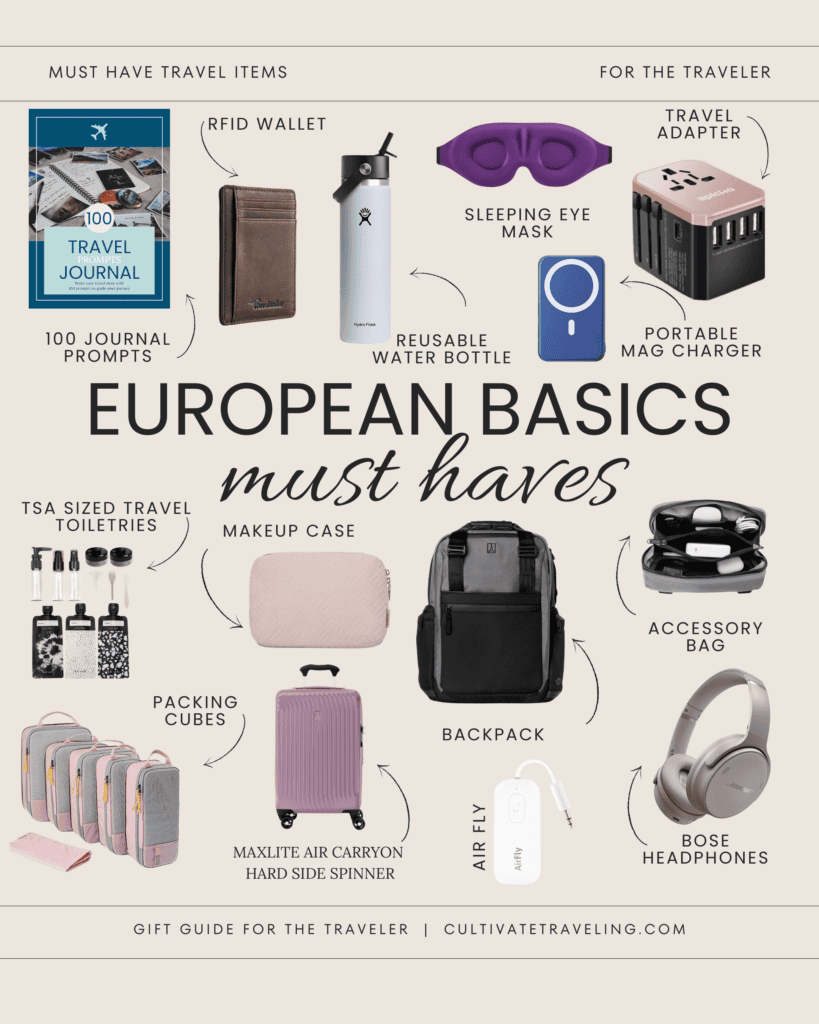
Travel Documents, Money, and Important Essentials for Europe
Before you start filling your suitcase with clothes and shoes, make sure you have the documents and essentials you’ll need to travel through Europe.
I always organize these items before packing anything else. Forgetting a sweater is inconvenient, but forgetting your passport can derail your entire trip!
Essential Travel Documents for Europe
Keep these documents organized and easy to access:
- Passport: Check the entry requirements for every country on your itinerary, including passport validity rules.
- Visas and travel authorizations: Verify whether you need a visa, an electronic travel authorization, or another entry document based on your nationality and destinations.
- Driver’s license: Bring it if you plan to rent a car. Check whether an International Driving Permit is required.
- Travel insurance: Save your policy details and emergency contact information.
- Transportation confirmations: Keep your flight, train, and other transportation reservations accessible.
- Hotel reservations: Save your accommodation addresses and booking confirmations.
- Tickets and reservations: Download confirmations for attractions, tours, and activities you’ve booked in advance.
I recommend keeping digital copies of important documents in a secure location you can access offline.
CT Tip: Before leaving home, download your hotel addresses, transportation tickets, and important reservations to your phone. You don’t want to depend on finding Wi-Fi when you arrive in a new city.
Money and Payment Essentials
You don’t need to carry large amounts of cash when traveling through Europe, but having more than one payment method is helpful.
Here’s what I recommend:
- At least two credit or debit cards, stored separately
- A small amount of local currency when appropriate
- A secure wallet or crossbody bag
- Access to your banking apps
- A backup payment method in case a card is lost or declined
Remember that not every European country uses the euro. For example, the United Kingdom uses pounds sterling, while Switzerland uses Swiss francs.
I prefer using a credit card for most purchases, but I keep some local cash available for smaller shops, markets, or unexpected situations.
Before departure, check whether your cards charge foreign transaction fees and review your bank’s international ATM fees.
CT Tip: When a payment terminal asks whether you want to pay in your home currency or the local currency, I always choose the local currency to avoid potentially unfavorable conversion rates.
Everyday Essentials for Exploring Europe
These are some of the smaller items I like to keep accessible during sightseeing days:
- Crossbody bag or small backpack: For your phone, wallet, water bottle, and daily essentials
- Reusable shopping bag: Useful for markets, grocery stores, and souvenirs
- Sunglasses and sun hat: Especially during warmer months
- Compact umbrella: Helpful for unexpected rain
- Reusable water bottle: Convenient for long sightseeing days
- Earplugs: Useful for flights, trains, and noisy hotel rooms
- eSIM or international phone plan: Helps you access maps, reservations, and transportation information while traveling
Having reliable mobile data makes navigating Europe much easier, especially when you’re checking train schedules, finding restaurants, or using maps in unfamiliar cities. If you’re unsure how international phone service works, my guide to using an eSIM for European travel explains what you need to know before departure.
A small day bag makes exploring European cities much easier, especially when you’re spending the day away from your hotel.
I also bring a foldable shopping bag because I love browsing local markets and often find something I want to bring home.
CT Tip: Keep your passport, medications, payment cards, and other irreplaceable essentials in your personal item when flying. That way, they’re still with you if your carry-on suitcase needs to be checked at the gate.
Electronics and Travel Accessories for Europe
A few carefully chosen travel accessories can make exploring Europe much easier, especially when you’re navigating train stations, finding your hotel, or spending an entire day sightseeing.
Since I usually travel with carry-on luggage, I focus on accessories that are lightweight, practical, and useful throughout the trip.
These are the electronics and travel essentials I regularly pack for Europe.
My Europe Travel Electronics Checklist
- Smartphone and charging cable
- Travel plug adapter compatible with your destinations
- Portable power bank
- Headphones or earbuds
- eSIM or international phone plan
- Luggage tracker, such as an Apple AirTag
- Camera and charger, if needed
- E-reader or tablet, if you regularly use one
You don’t need every gadget available. Choose the electronics you’ll actually use.
Travel Plug Adapter for Europe
One of the most important things to pack for Europe is the correct plug adapter.
Different European countries use different electrical outlets. For example, much of continental Europe uses Type C, E, or F plugs, while the United Kingdom and Ireland use Type G.
I prefer a universal travel adapter with USB ports because it allows me to charge multiple devices without carrying several separate chargers.
Important: A plug adapter changes the plug shape, but it doesn’t convert electrical voltage. Check that your electronics support the voltage used at your destination, particularly hair dryers, curling irons, and other heat-producing appliances.
Most modern phone and laptop chargers support multiple voltages, but always check the label before using them abroad.
Portable Power Bank
A portable power bank is one of my must-have travel accessories.
I once ran out of phone battery while exploring York, England. Without a paper map or access to my navigation app, I had no idea where I was going.
That experience convinced me never to leave my hotel without a backup charger.
Now I keep a fully charged power bank in my day bag, especially when I’m using my phone for maps, photos, tickets, and transportation information.
CT Tip: Keep your power bank in your carry-on or personal item when flying. Airlines have restrictions on lithium batteries, so check your airline’s rules before departure.
Luggage Trackers
I like using luggage trackers to help keep tabs on my bags during flights and train travel.
A small tracker, such as an Apple AirTag, takes up almost no space and can provide additional peace of mind if your luggage is delayed or misplaced.
I recommend putting one in each suitcase, whether you’re checking a bag or traveling carry-on only.
Noise-Canceling Headphones or Earbuds
Between long-haul flights, train journeys, and occasional noisy hotel rooms, headphones are one accessory I use regularly.
Noise-canceling earbuds are especially convenient because they take up very little space.
I also keep a pair of simple earplugs available for sleeping.
Download Offline Maps and Travel Apps
Your phone can be one of your most useful travel tools, but you shouldn’t depend entirely on having an internet connection.
Before arriving in a new destination, I download offline maps and save important transportation information.
Google Maps allows you to download maps for offline use, although some features require an internet connection.
I also save hotel addresses, train tickets, and attraction reservations so they’re easy to access.
CT Tip: Download your maps and travel documents before leaving your hotel. It’s much easier than trying to find Wi-Fi when you’re standing outside a train station in an unfamiliar city.
Other Small Travel Accessories Worth Packing
Depending on your itinerary, consider bringing:
- A lightweight reusable water bottle
- A foldable tote bag for shopping
- A compact umbrella
- Packing cubes for organizing your suitcase
- A small cable organizer
- A luggage tag with your contact information

The goal isn’t to bring more accessories. It’s to pack the few items that make traveling through Europe more comfortable and convenient.
Choosing the Best Luggage for Europe
One of the biggest decisions when packing for Europe is whether to travel with a carry-on suitcase or check a bag.
After years of traveling throughout Europe, I’ve learned that packing lighter makes getting between destinations much easier, especially when you’re traveling by train, navigating cobblestone streets, or staying in older hotels.
I typically travel carry-on only, particularly during spring, summer, and fall. However, I sometimes check a suitcase for winter trips when heavier coats, boots, and extra layers take up more space.
The best luggage for Europe depends on your itinerary, the season, and how often you’ll be changing accommodations.
Carry-On Suitcase: My Preferred Choice for Europe
For most European trips, I prefer a lightweight wheeled carry-on suitcase.
Traveling carry-on only means I can move between destinations without managing an oversized bag. It’s especially convenient when navigating busy train stations, climbing stairs, or walking to a hotel.
A carry-on also encourages me to be more selective about what I pack.
Before choosing your suitcase, check the size and weight restrictions for every airline on your itinerary. European airlines can have different baggage allowances, particularly on shorter flights.
CT Tip: If you’re planning to travel between several European cities by train, choose a suitcase you can comfortably lift onto a luggage rack or carry up a flight of stairs. You’ll appreciate it when you’re moving between destinations.
If you’re planning to explore several European cities by train, packing light is only part of the preparation. Understanding train tickets, luggage storage, and station connections can make your journey much smoother. My UK and Europe train travel resources will help you feel more confident navigating Europe’s rail networks.
Travel Backpack: An Alternative for Multi-City Trips
A travel backpack can be a good option if you’re moving frequently, staying in accommodations without elevators, or visiting destinations with lots of stairs and uneven streets.
It keeps your hands free and eliminates the need to roll a suitcase over cobblestones.
However, backpacks aren’t automatically the best choice for everyone. A fully packed backpack can become uncomfortable, particularly during long walks.
Choose luggage that’s comfortable for you to carry and maneuver, not simply what another traveler recommends.
When I Check a Suitcase for Europe
Although I prefer carry-on travel, I sometimes check a bag for winter trips.
When I’m visiting European Christmas markets or traveling somewhere with colder weather, bulky sweaters, waterproof boots, and heavier outerwear can make carry-on packing more challenging.
I would rather check a suitcase than sacrifice the clothing I need to stay warm and comfortable.
If you’re planning a winter trip, consider your destination’s temperatures, planned outdoor activities, and how often you’ll be changing hotels before deciding which luggage to bring.
Don’t Forget Your Personal Item or Day Bag
In addition to my suitcase, I bring a personal item for the flight and a smaller bag for exploring during the day.
Your personal item should keep important belongings accessible, including:
- Passport and travel documents
- Wallet and payment cards
- Phone and charging cable
- Portable power bank
- Prescription medications
- Headphones
- Essential valuables
- A lightweight layer for the flight
For sightseeing, I prefer a comfortable crossbody bag or small backpack that holds my everyday essentials without feeling bulky.
A secure, easy-to-carry day bag is particularly useful when you’re exploring cities, visiting museums, or spending the day away from your hotel.
Packing Cubes and Luggage Organization
Packing cubes are one of my favorite ways to keep my suitcase organized.
I use them to separate clothing categories and make it easier to find what I need without unpacking everything.
They can also help keep a capsule wardrobe organized when you’re moving between hotels.
Just remember that packing cubes don’t reduce the actual weight of your luggage. Even if everything fits, you still need to stay within your airline’s baggage limits.
CT Tip: Before leaving home, practice lifting your packed suitcase and carrying it up a flight of stairs. If it’s difficult at home, it won’t get easier when you’re navigating a European train station.
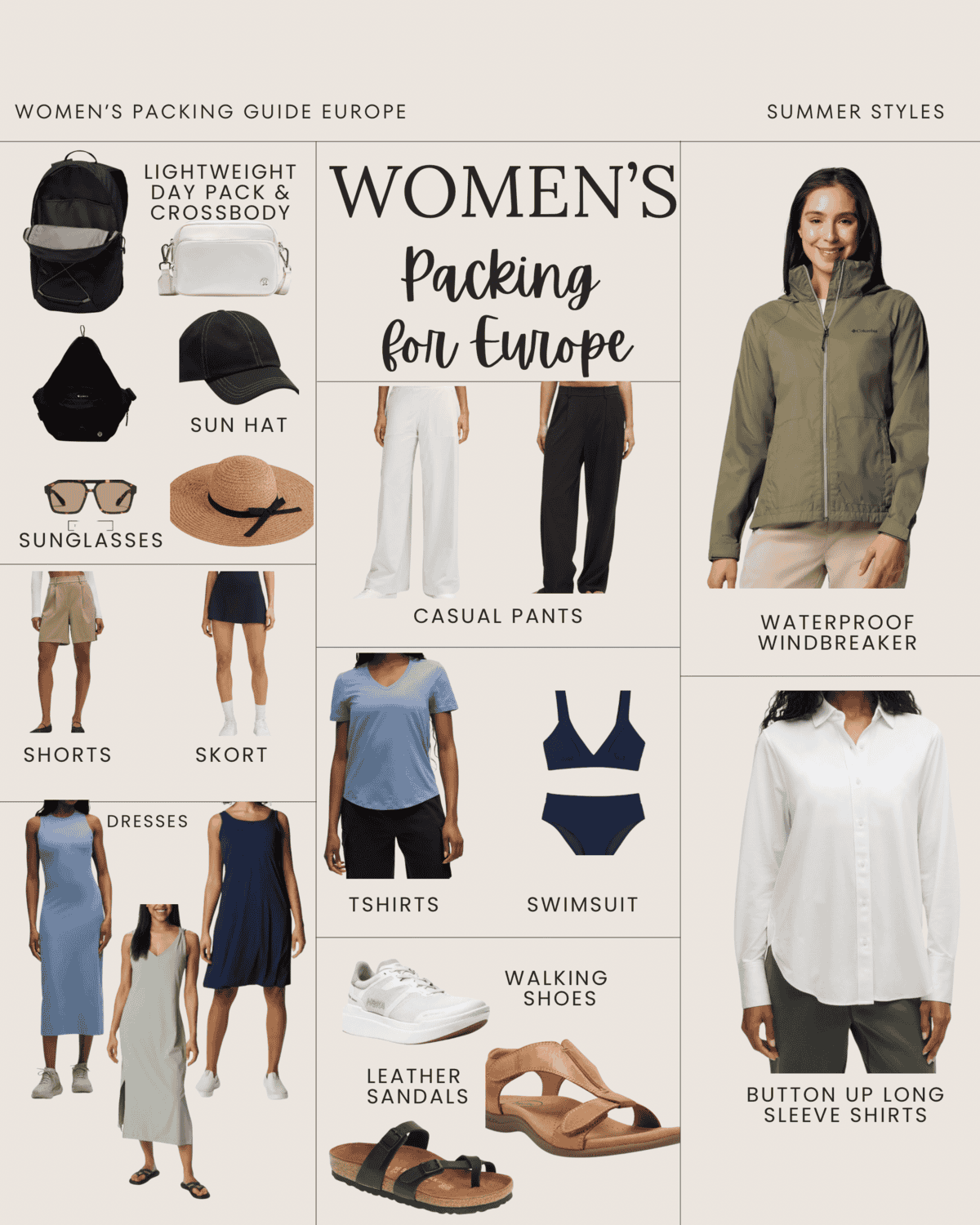
Atlas Explorer Day Pack / Everywhere Crossbody Bag 2L / Curved Crossbody Bag 3L / Classic Black Baseball Hat / Quay Soundcheck Sunglasses / Women’s Global Adventure™ Packable Hat III / Daydrift Pleated High-Rise Short 7″ / Align™ High-Rise Skirt / All Aligned Ribbed Midi Dress / Women’s PFG Freezer™ III Dress / Women’s Chill River™ Midi Dress / Daydrift High-Rise Trouser / Swift Mid-Rise Wide-Leg Pant / Love V-Neck T-Shirt / Longline V Neck Bralette & Navy Classic High Waist Bikini Set / Hoka Transport X / Taos The Show / Mayari Birko-Flor Sandal / Women’s Switchback™ IV Jacket / Women’s Anytime Lite™ Long Sleeve Shirt
Europe Packing Lists by Season: Summer, Spring, Fall, and Winter
What you pack for Europe depends heavily on when and where you’re traveling.
A summer trip to Italy requires a very different wardrobe than a December visit to the Christmas markets in Germany or Switzerland. Even within the same season, temperatures can vary significantly between northern and southern Europe.
I typically travel through Europe with carry-on luggage during spring, summer, and fall. For winter trips, I sometimes check a suitcase to accommodate heavier clothing.
These seasonal packing lists are designed for approximately two weeks of travel, assuming you’ll do laundry at least once. Adjust the quantities based on your destination, itinerary, and personal preferences.
Summer Packing List for Europe (June–August)
Summer is one of my favorite times to explore Europe, but packing requires a little planning. Southern destinations such as Italy and Greece can be extremely hot, while northern destinations may still experience cool evenings and rainy days.
Summer clothing checklist
- 5 lightweight tops or T-shirts
- 2 pairs of shorts
- 2 pairs of lightweight pants or skirts
- 1–2 dresses or dressier outfits
- 1 lightweight sweater or cardigan
- 1 packable rain jacket
- 2 pairs of comfortable walking shoes or sandals
- 7 pairs of underwear
- 5–7 pairs of socks
- 1–2 sets of sleepwear
- Swimwear, if needed
- Sun hat and sunglasses
Choose breathable fabrics and pieces that work together. Lightweight clothing makes it easier to pack carry-on only, even for longer trips.
For sightseeing days, I prefer comfortable walking shoes rather than relying exclusively on sandals. Historic European cities often have cobblestones, stairs, and uneven sidewalks.
CT Tip: Don’t assume every European destination will be hot in summer. Check the forecast for each stop, especially if you’re visiting London, Scotland, or northern Europe.
Spring and Fall Packing List for Europe (March–May and September–November)
Spring and fall are excellent times to explore Europe, but changing temperatures can make packing more challenging.
You might experience warm afternoons, chilly mornings, and rain, sometimes all in the same day.
This is when a capsule wardrobe and lightweight layers become especially useful.
Spring and fall clothing checklist
- 4–5 tops, including a mix of short- and long-sleeve options
- 3 pairs of pants or jeans
- 1 skirt, dress, or additional bottom
- 2 sweaters or cardigans
- 1 weather-appropriate jacket
- 1 packable rain jacket or waterproof outer layer
- 2 pairs of comfortable walking shoes
- 7 pairs of underwear
- 5–7 pairs of socks
- 1–2 sets of sleepwear
- 1 lightweight scarf
- Compact umbrella
The key is layering. A lightweight sweater and waterproof jacket give you more flexibility than packing several bulky outfits.
For early spring or late fall, you may need warmer layers, especially in northern Europe or mountainous areas.
CT Tip: When traveling to several European destinations, check the forecast for all of them before packing. The weather in Rome can be very different from London or Edinburgh during the same week.
Winter Packing List for Europe (December–February)
Winter travel requires a different packing strategy, particularly if you’re visiting northern Europe or exploring outdoor Christmas markets.
I’ve traveled to European Christmas markets during the colder months, and staying warm makes a big difference when you’re spending hours outside.
This is also when I sometimes choose to check a suitcase rather than force everything into a carry-on.
Winter clothing checklist
- 3 thermal or moisture-wicking base-layer tops
- 3 sweaters or warm tops
- 2–3 pairs of warm pants
- 1–2 thermal leggings or base-layer bottoms
- 1 insulated winter coat
- 1 pair of comfortable waterproof boots
- 1 optional second pair of comfortable shoes
- 7 pairs of underwear
- 5–7 pairs of warm socks, preferably including wool options
- 1 warm hat
- 1 pair of insulated gloves
- 1 scarf
- 1–2 sets of sleepwear
- Warm pajamas or loungewear, if needed
For cold destinations, focus on layers that trap warmth without restricting movement. Thermal base layers, a warm midlayer, and a weather-resistant outer layer work well together.
Waterproof footwear is particularly helpful when you’re walking through rain, snow, or slushy streets.
For milder winter destinations, such as parts of southern Spain or Italy, you may not need the same level of insulation.
CT Tip: If you’re visiting European Christmas markets, prioritize a warm coat, comfortable waterproof boots, and gloves. You’ll spend more time standing outdoors than you might expect, especially in the evenings.
Planning a European Christmas market trip or another cold-weather getaway? Winter packing takes a little extra preparation, especially when you’ll be spending hours outdoors. My cold-weather packing guide covers additional essentials to help you stay comfortable while exploring in colder temperatures.
How to Adjust Your Packing List for Shorter or Longer Trips
You don’t need to pack an entirely different wardrobe for every trip length.
For 3–5 days: Reduce your clothing quantities and focus on outfits you can mix and match. You may not need to do laundry.
For 7–10 days: Use a compact capsule wardrobe and consider washing a few items if necessary.
For 14 days or longer: Pack approximately one week’s worth of clothing and plan to do laundry during your trip.
I prefer doing laundry over bringing additional outfits, particularly when traveling between European cities by train.
Before departure, check whether your hotel or vacation rental has laundry facilities or whether there’s a laundromat nearby.
Remember that these lists are starting points. Your final packing list should reflect your itinerary, the weather, and the activities you have planned.
My Best Tips for Packing Light for Europe
After years of traveling throughout Europe, I’ve learned that packing light is less about sacrificing what you love and more about choosing what you’ll actually use.
Here are the habits that make carry-on travel easier for me:
- Pack for your itinerary. Bring clothing for activities you’ve actually planned rather than every possible occasion.
- Choose versatile outfits. Stick to a simple color palette so you can mix and match your clothing.
- Prioritize comfortable shoes. Bring shoes you’ve already tested on long walks.
- Plan for laundry. On longer trips, I pack approximately one week’s worth of clothing and wash items along the way.
- Organize with packing cubes. They make unpacking and repacking easier when changing hotels.
- Check the weather for every destination. Pack layers that work together instead of several bulky jackets.
- Leave room for souvenirs. I love exploring local markets, so I always save a little suitcase space for purchases.
CT Tip: Before closing your suitcase, remove one or two items you packed only “just in case.” You probably won’t miss them, but you’ll appreciate the extra space.
What NOT to Pack for Europe
Knowing what to leave at home is just as important as knowing what to pack for Europe.
I used to be a “just in case” packer, bringing extra outfits, shoes, and accessories I rarely used. After dragging heavy luggage through train stations and across cobblestone streets, I’ve learned that packing less makes traveling through Europe much easier.
Here are the things I recommend leaving behind.
1. Oversized or Heavy Luggage
Unless your trip requires additional equipment or bulky winter clothing, avoid bringing a suitcase that’s difficult to lift or maneuver.
European train stations, historic hotels, and older city centers often involve stairs, narrow sidewalks, and uneven streets.
I prefer traveling carry-on only whenever possible, especially during spring, summer, and fall.
2. Uncomfortable Shoes and High Heels
European vacations usually involve more walking than you expect.
On a trip to Rome, I packed cute shoes for an evening out and regretted that decision after about 20 minutes on the cobblestones.
Now I choose comfortable shoes that work for sightseeing and evenings out.
Unless you have a specific event planned, leave high heels and impractical shoes at home.
3. Too Many Outfits
You don’t need a different outfit for every day of your trip.
Instead of packing several “just in case” outfits, choose clothing that mixes and matches.
A capsule wardrobe makes it easier to pack light while still having options for different activities.
4. Full-Size Toiletries
Large bottles of shampoo, conditioner, and skincare products take up valuable suitcase space.
I bring travel-size versions of my everyday products, especially when traveling carry-on only.
If you run out of something, you can usually purchase replacement toiletries at a local pharmacy or supermarket.
Remember to check the liquid restrictions at the airports you’ll be traveling through.
5. Hair Tools That Aren’t Compatible With European Voltage
Before packing a hair dryer, curling iron, or straightener, check whether it supports the electrical voltage used in your destination.
A plug adapter changes the shape of the plug, but it doesn’t convert voltage.
Many European countries use approximately 230 volts, which can damage appliances designed only for 120 volts.
If your styling tool isn’t compatible, leave it at home and use an appropriate alternative.
6. Expensive Jewelry and Unnecessary Valuables
I recommend leaving irreplaceable jewelry and other unnecessary valuables at home.
You’ll have fewer things to worry about when moving between hotels, using public transportation, and exploring busy tourist attractions.
Bring a few versatile accessories instead of your entire jewelry collection.
7. Too Many Electronics and Accessories
It’s easy to pack gadgets you think might be useful but never actually use.
Before adding another electronic device or travel accessory, ask yourself whether it serves a specific purpose on your trip.
I prioritize my phone, portable charger, travel adapter, and the electronics I know I’ll use regularly.
CT Tip: When you’re deciding whether to pack something, ask yourself: “Would I be willing to carry this through a train station and up several flights of stairs?” If the answer is no, it probably doesn’t belong in your suitcase.
Last-Minute Europe Packing Checklist: Don’t Forget These Essentials
You’ve chosen your outfits, organized your toiletries, and packed your suitcase. Before heading to the airport, there are a few final things worth double-checking.
After years of traveling through Europe, I’ve learned that the smallest forgotten items can sometimes cause the biggest inconveniences.
Easily Forgotten Items for Europe
Before closing your suitcase, check that you’ve packed:
- Reusable shopping bag for markets and grocery stores
- Small wallet or coin purse for local currency
- Laundry detergent sheets or a small travel laundry kit
- Pocket tissues for public restrooms
- Portable power bank and charging cables
- Travel plug adapters for every country you’re visiting
- Prescription medications and necessary documentation
- Comfortable socks and blister bandages
- Compact umbrella or packable rain jacket
- Washcloth, if you prefer using one and your accommodations don’t provide it
You won’t need every item on every trip, but these are worth considering based on your itinerary.
The Day-Before-Departure Checklist
Use this final checklist before leaving for Europe:
- Check that your passport meets your destinations’ entry requirements.
- Confirm any required visas or travel authorizations.
- Save copies of your travel documents in a secure, accessible location.
- Download flight, train, hotel, and attraction confirmations.
- Check the weather forecast for each destination.
- Confirm your luggage meets your airlines’ size and weight limits.
- Charge your phone, power bank, and other electronics.
- Pack essential medications, valuables, and travel documents in your personal item.
- Check that your phone plan or eSIM is ready for international travel.
- Review your travel insurance details.
- Share your itinerary and emergency contact information with someone you trust.
- Leave a little room in your suitcase for souvenirs.
CT Tip: I like to finish packing the day before departure rather than the morning of my flight. It gives me time to double-check my essentials without rushing.
And remember, you don’t need to pack for every possible situation. Most everyday items can be purchased in Europe if you forget something.
The important things are your travel documents, medications, payment methods, and anything you can’t easily replace abroad.
Related Posts to Packing list for European trips
- The Ultimate Cruise Packing List Everyone Needs
- The Ultimate Men’s Packing List for a Europe Trip in Any Season
- Cold weather essentials Packing list for winter travel
- Best Shoes for European Travel: Walk in Style & Comfort
- The Ultimate Guide to Using an eSIM for European Travel
- Europe Train Travel Confidence Kit
Frequently Asked Questions About Packing for Europe
What should I pack for my first trip to Europe?
Start with versatile clothing, two pairs of comfortable walking shoes, weather-appropriate layers, toiletries, prescription medications, travel documents, and essential electronics.
You’ll also need a plug adapter compatible with your destinations, a portable power bank, and a comfortable day bag.
Check the weather and your planned activities before deciding how much clothing to bring. A capsule wardrobe is a great starting point for first-time visitors.
How can I pack light for two weeks in Europe?
Pack approximately one week’s worth of clothing and plan to do laundry during your trip.
I typically travel through Europe with carry-on luggage only, especially during spring, summer, and fall. I choose clothing that mixes and matches, limit my shoes to two or three pairs, and use packing cubes to stay organized.
You don’t need 14 different outfits for a two-week vacation!
How many pairs of shoes should I bring for a European vacation?
I recommend bringing two pairs of comfortable walking shoes, with an optional third pair for special activities or evenings out.
European vacations often involve cobblestone streets, stairs, and long sightseeing days. Choose shoes you’ve already worn on longer walks rather than packing brand-new footwear.
For winter travel, comfortable waterproof boots may be more useful than an additional pair of sneakers.
Can I travel to Europe with carry-on luggage only?
Absolutely! I regularly travel through Europe with carry-on luggage, even on longer trips.
The key is packing a capsule wardrobe, choosing lightweight clothing, and planning to do laundry when necessary.
Winter travel can be more challenging because of bulky coats and boots. I sometimes check a suitcase for European Christmas market trips when I need additional warm clothing.
Always check your airline’s carry-on size and weight restrictions before departure.
What should I pack for Europe in different seasons?
For summer, focus on breathable clothing, comfortable shoes, sun protection, and a lightweight layer.
During spring and fall, pack versatile layers, a rain jacket, and clothing that works in changing temperatures.
For winter, bring thermal base layers, warm sweaters, an insulated coat, gloves, and appropriate footwear.
Remember that weather varies significantly across Europe. Check the forecast for your specific destinations rather than packing based on the season alone.
Do I need a travel adapter for Europe?
If you’re traveling from the United States, you’ll generally need a plug adapter for your electronics.
However, not every European country uses the same outlet. The United Kingdom and Ireland use Type G plugs, while many continental European countries use Type C, E, or F.
A plug adapter doesn’t convert voltage, so check whether your devices support the electrical voltage at your destination.
What should I avoid packing for Europe?
Avoid oversized luggage, uncomfortable shoes, too many outfits, unnecessary valuables, and electronics you won’t use.
If you’re traveling carry-on only, skip full-size liquid toiletries that exceed airport security limits.
Also, avoid bringing hair tools that aren’t compatible with your destination’s electrical voltage.
The goal is to pack what you’ll actually use, not everything you might possibly need
Your itinerary plays a big role in deciding what belongs in your suitcase. Knowing which cities you’re visiting, how you’ll travel between them, and what activities you’ve planned makes packing much easier. If you’re still organizing your trip, my guide on how to create a travel itinerary will help you build a flexible plan without feeling overwhelmed.
Final Thoughts: Pack Smarter for Your European Adventure
Packing for Europe doesn’t have to be complicated. The goal isn’t to bring everything you might possibly need. It’s to pack the essentials that will help you enjoy your trip without being weighed down by your luggage.
After years of traveling throughout Europe, I’ve learned that a versatile wardrobe, comfortable walking shoes, and a few practical travel accessories make all the difference.
I typically travel carry-on only during spring, summer, and fall. For winter trips, I sometimes check a suitcase to accommodate warmer clothing. Either way, I focus on packing for my actual itinerary rather than every possible scenario.
And remember, if you forget something small, you can usually purchase it once you arrive.
Download My Free Printable Europe Packing List
Want an easy way to make sure you haven’t forgotten anything?
I’ve created a free printable Europe Packing List for Men & Women to help you organize everything before your trip.
Inside, you’ll find:
- A practical packing checklist for European travel
- Clothing and travel essentials for men and women
- Seasonal packing tips
- Space to customize the list for your destination and itinerary
Download your free Europe packing list, check off your essentials, and spend less time worrying about what to bring.
Because the best part of planning a European vacation isn’t packing your suitcase. It’s everything you’ll experience once you arrive!
Go Grab Life. And don’t forget to wear sunscreen.
Happy Exploring!